
Black mold removal in Jacksonville runs $500–$6,000 for most homes — single rooms $1,000–$4,000, larger scopes $3,000–$6,000. Removal follows extent and moisture source, not species — and on the First Coast the source is usually the attic or the AC closet, the market’s two first colonies.
What the color means, why those two rooms lead, and the removal that lasts.
What “black mold” is — and what the color doesn’t tell you
The phrase points at Stachybotrys chartarum, a dark, slow-growing mold that favors chronically wet cellulose — drywall paper, wet wood. But many common molds grow dark, and EPA remediation guidance keys on extent and moisture rather than species: substantial indoor growth gets removed and its water source fixed, whatever the colony is named. Species testing earns its $500–$1,500 for medical questions, disputes, and clearance. What the color reliably says in Duval County: something has stayed wet — and the shortlist of where starts with two rooms.
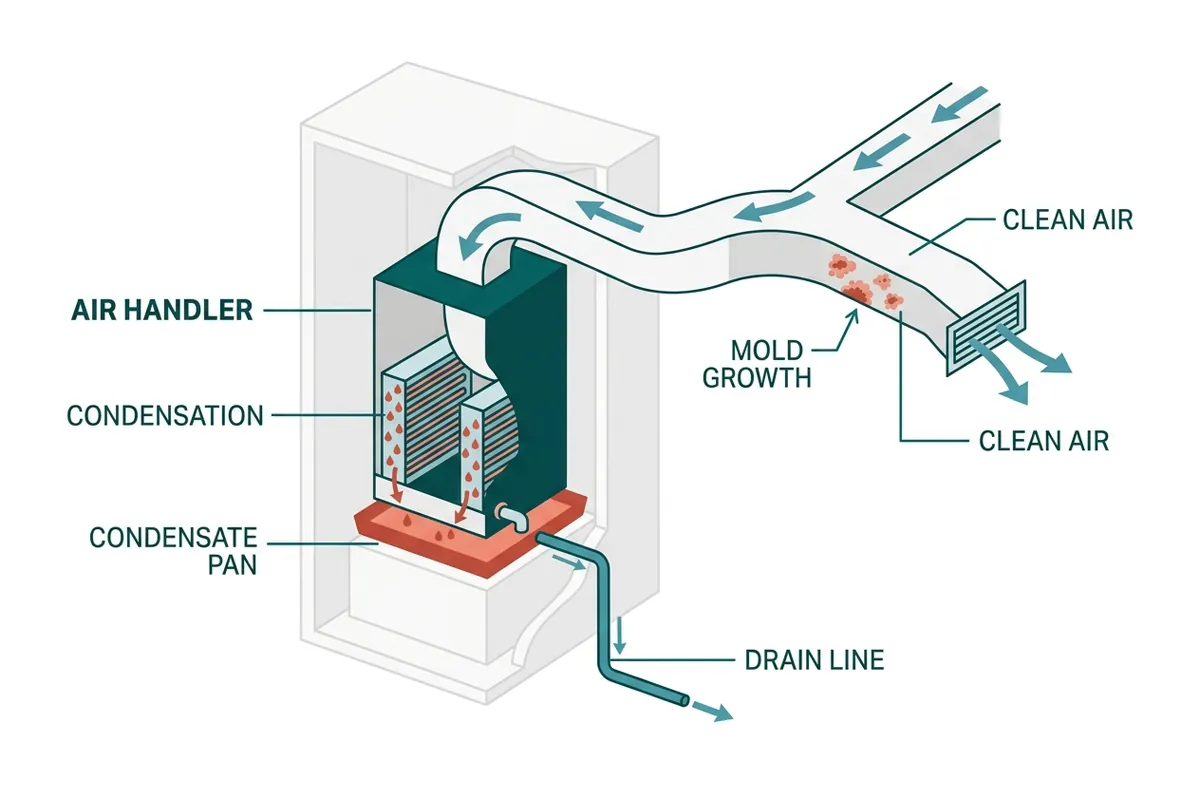
The two first colonies
Jacksonville’s mold geography is distinctive: attics and AC closets are the usual first colonies. The attic version is a condensation story — 51 inches of rain peaking midsummer through storm season loads the air, sun-baked sheathing cools hard at night, and moisture films the underside of the roof deck wherever ventilation stalls (the attic page reads those streak patterns in detail). The AC closet version is an ecosystem: a cold coil, a condensate pan, stagnant air, and dust in a warm cabinet — everything a colony orders (the AC cleanup page covers the air path). Growth appearing elsewhere — wall bases, closets, behind furniture — usually traces back through one of those two rooms or a storm-season leak.
Cleanup or remediation — the honest line
| Situation | Reasonable response | Typical cost |
|---|---|---|
| Small patch on tile or block | Household cleanup, then watch it | Supplies |
| Growth on drywall or trim | Material removal — porous roots regrow through cleaners | $500–$2,000 small scope |
| One room, or the AC air path | Contained remediation, HEPA, negative air | $1,000–$4,000 |
| Multi-room or attic-wide | Contained remediation plus ventilation work | $3,000–$6,000 |
| Fresh storm or leak water | Dry-out first, then assess | Scoped after drying |
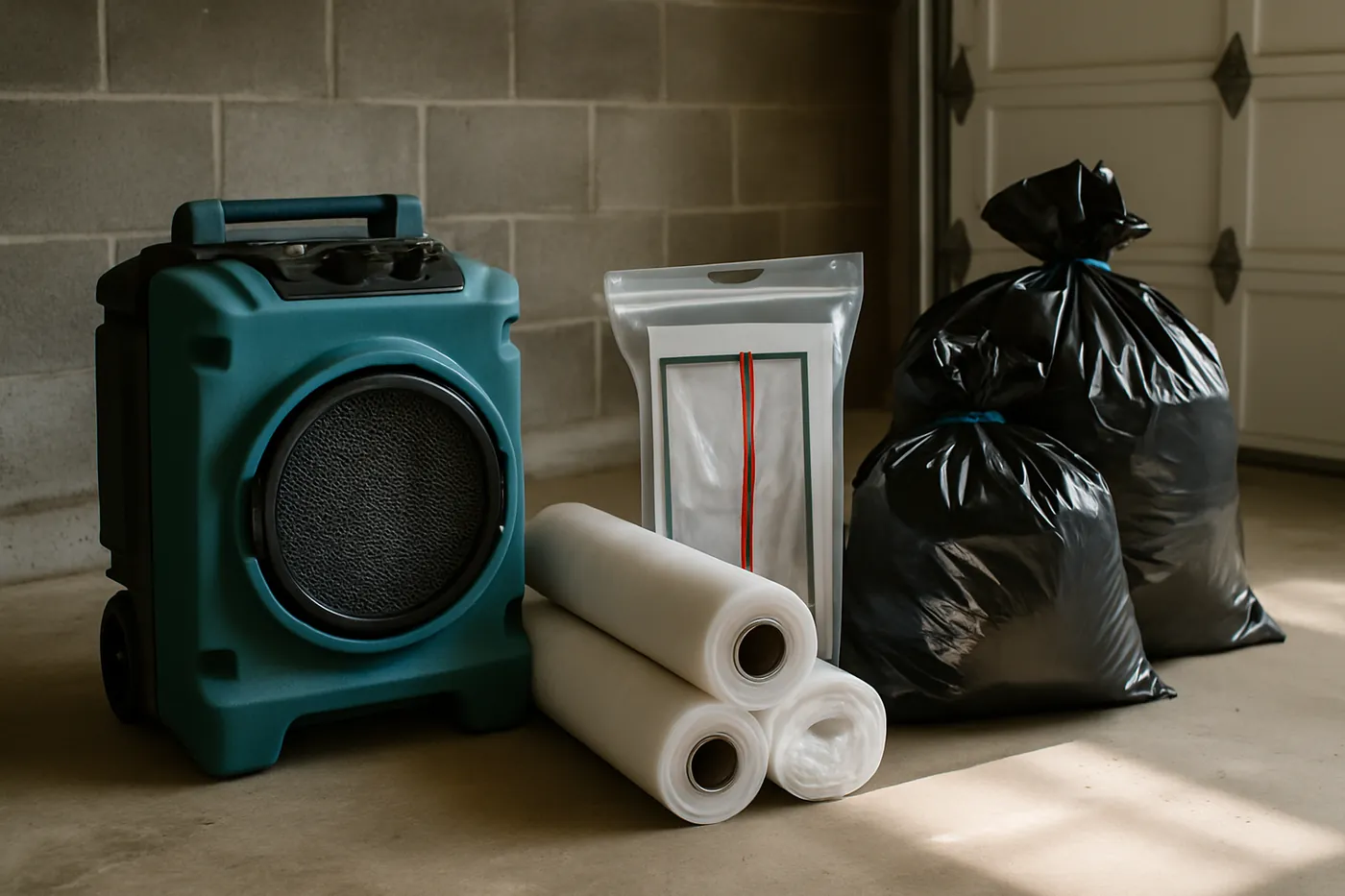
Removal that holds through storm season
Containment before disturbance, HEPA filtration throughout, colonized porous material out, block and framing cleaned — then the room-matched moisture fix: attic airflow for the condensation colony, condensate and closet ventilation for the AC one, roofing or flashing where a storm found a way in. A removal that skips its room’s fix is a subscription. Florida licenses mold assessors and remediators through DBPR — verify any contractor’s license before hiring, including ours, and weigh every bid by whether it names the moisture source. The cost guide prices each scope line by line.
What clearance testing actually proves
The job isn’t finished when the visible growth is gone; it’s finished when an independent test says the air matches an unaffected part of the house. Post-remediation verification looks at three things: the work area is visibly clean and dry, the containment held, and airborne spore counts inside are at or below the outdoor baseline taken the same day. That outdoor comparison is the part people miss — mold spores exist everywhere outdoors, so “zero” is not the standard and any company promising it is selling something. Insist the sampling be done by someone who isn’t doing the remediation, and keep the report. It is what you hand a buyer, an adjuster, or a landlord when the question comes up later.
Black mold questions, straight answers
Is black mold more dangerous than other molds?
The color doesn't decide the danger. 'Black mold' usually points at Stachybotrys, but many common molds grow dark, and EPA-guided remediation keys on extent and moisture source rather than species. Substantial indoor growth gets removed and its water source fixed whatever the name; testing supplies the species when a doctor or dispute needs it.
Why do Jacksonville colonies start in attics and AC closets?
Because that's where this market's moisture concentrates. Fifty-one inches of rain peaks midsummer through storm season, humid attic air condenses under sun-baked sheathing at night, and the AC closet packs a cold coil, a drain pan, and stagnant air into one warm cabinet. Those two rooms are the local early-warning system — most First Coast mold stories start in one of them.
Can I just bleach it?
On hard, non-porous surfaces — tile, block — household cleanup is reasonable. On drywall or wood, bleach wets the material, kills the surface, and leaves roots in a damp substrate: the regrowth cycle. Growth beyond a few square feet, in the air path, or returning after cleaning is containment-and-removal work, not a spray bottle.
What does removal involve in a block-on-slab house?
Containment with negative air, HEPA filtration, colonized drywall and trim out — block itself usually cleans rather than demolishes — then the moisture fix that decides recurrence: attic ventilation, AC condensate and closet airflow, or the leak. Florida licenses mold remediators through DBPR; verify any contractor's license before hiring, including ours.
What does black mold removal cost in Jacksonville?
Most residential remediation runs $500 to $6,000 by spread — single-room scopes commonly $1,000-$4,000, larger multi-room or air-path jobs $3,000-$6,000. Species doesn't move the price; extent and access do. Testing runs $500-$1,500 where clearance or a dispute needs laboratory numbers.
Book a Jacksonville mold inspection
Tell us what you're seeing — spots on a wall, a musty room, a leak that got away — and we'll schedule an inspection with photos and moisture readings. Active water gets priority scheduling.